

UX/Ui Design
AI for UX Design: Why It’s Not the Enemy and Why Lack of Clarity Is




Being in the IT industry as a UX/UI designer, surrounded by AI hype that screams at us every time we open LinkedIn, Reddit, or X, and hearing about new features across platforms, about how designers are “done” and how we can all pack our things and go, I couldn’t help but wonder: wait… this doesn’t make sense. UX is more important than ever.
Sure, some managers who’ve been pressured to carry out the “AI transformation” at their organizations, without even really knowing what it is, or those who have been riding the AI hype train from day one might not realize that.
But, all those products, services, and solutions built with the help of AI are still aimed at people. Yes, AI can help speed things up and streamline processes, but it still requires a human behind the steering wheel. And that includes UX design.
How Advanced Are We at Using AI for UX Design – or in General?
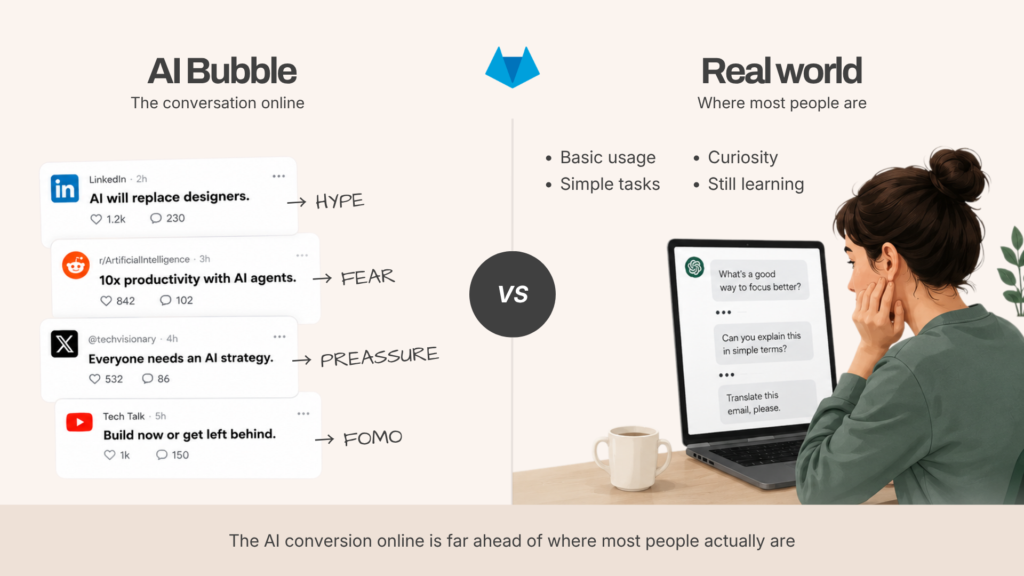
One moment that really stood out to me was talking to people outside of my industry. I stopped and realized something simple, but important: most people are not that familiar with AI or following these trends closely.
Yes, they’ve heard about AI assistants like ChatGPT, and they might use it as a “personal doctor” or a faster way to get information instead of googling. But that’s about it.
If we look at the data, only a very small percentage of people can be considered advanced AI users, people who truly understand and explore its full potential.
At the same time, most companies have heard about AI, AI agents for HR, finance, marketing, or sales, and they feel the need to “put it somewhere.” The problem is, they often don’t know where, or how it will actually help them.
And this is where something interesting happens: FOMO.
FOMO Is Bigger Than Ever in the AI Era
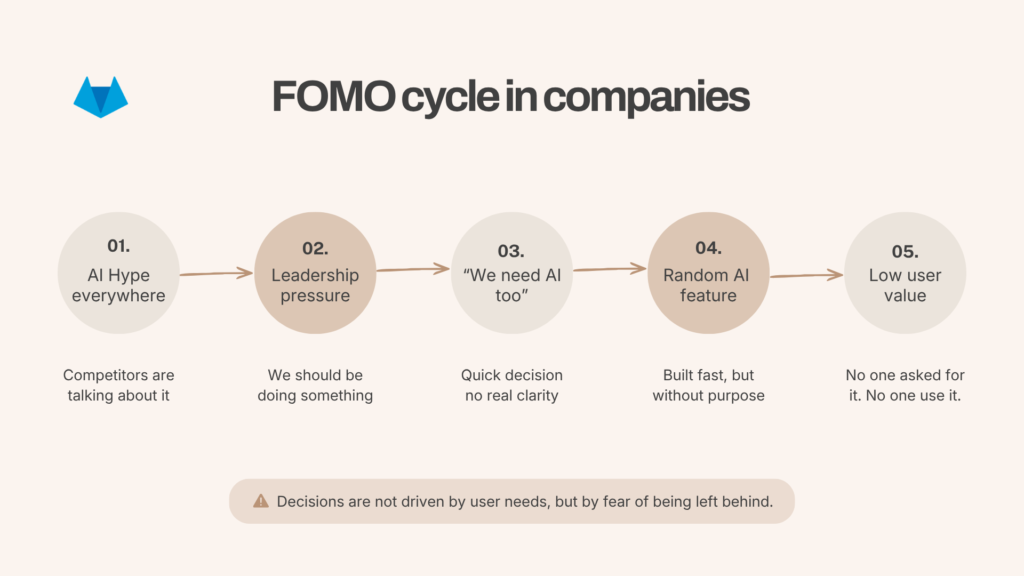
This is not just curiosity. It is real pressure, not only from getting left behind the competitors, but also from within the organizations themselves.
Teams feel like they have to “do something with AI”, not because they have a clear need, but because everyone else is doing it. That’s what FOMO looks like in companies today. Decisions are not driven by user needs, but by fear of being left behind.
You can see it in products that suddenly get AI features that no one asked for and very few people actually use.
But on the other side there are people. Not “users.” People. People who are trying to understand where they fit into all of this. For many of them, AI doesn’t feel like an opportunity. It feels like uncertainty. Sometimes even a threat.
Not because they don’t want to learn, but because they don’t know what is expected from them anymore.
The Pushback Against AI Is Real
We are also seeing resistance inside companies. Employees are often expected to adopt AI tools in their daily work, but many hesitate. Not because they reject change, but because they don’t fully trust it, or don’t understand how it fits into their role yet.
And instead of addressing that, some companies try to force adoption, sometimes even bringing external pressure to “speed it up.”
But forcing people is not the solution. What we actually need is education, empathy, and understanding. We need to listen to people, understand their needs, their fears, and their problems.
Ask better questions. Design with clarity instead of assumptions.
Because today, building something is not the hard part anymore. We can build almost anything, quickly, easily, and at scale. The real challenge is knowing what should be built, and why.
The Role of UX Remains the Same
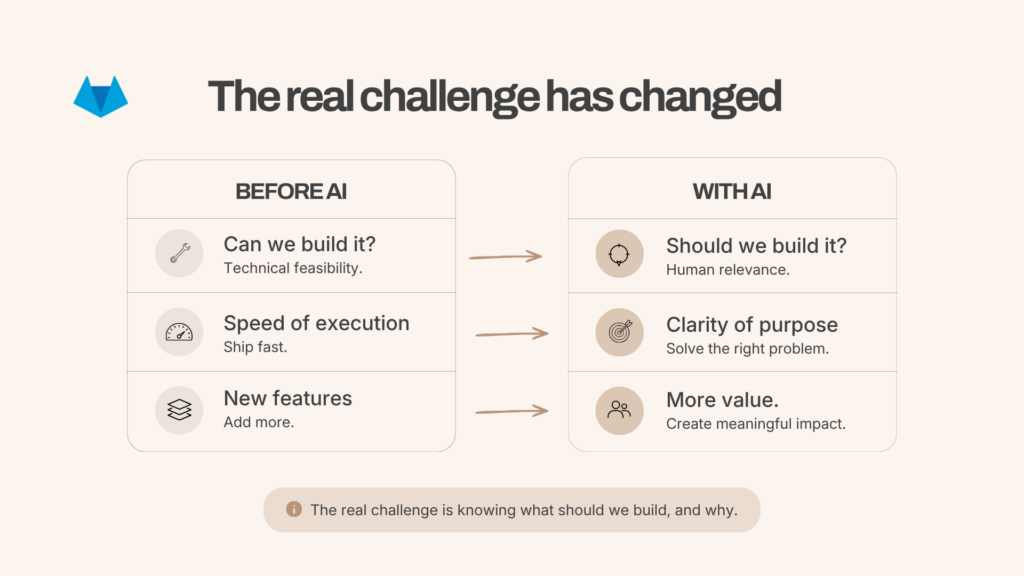
Good UX in the age of AI is not about adding more intelligence to systems. It’s about making that intelligence usable, understandable, and trustworthy. It’s about designing for people who are curious, but also skeptical.
People who want help, but still want control. People who don’t want to feel replaced, but supported.
So maybe the real question is not: “How fast can we adopt AI?”, but rather: “Are we building something people actually need, and are ready to use?”
Putting People and Their Needs First
At the end of the day, it’s about being clear and intentional about how we build things, especially with AI, which has lowered that barrier for entry. Because without clarity, AI becomes slop or just noise.
Without trust, it becomes resistance. And without understanding people, it becomes irrelevant. And that’s why UX is not going anywhere. And it is here to stay.
If anything, this is exactly the moment where it matters the most.
Ready to introduce clarity into your organization and its AI initiatives? Then reach out to our experts to book a strategy call or take our AI readiness calculator to see where your company stands when it comes to AI transformation!
Related blog posts:
Company Update
Most software projects don’t fail at writing code. They fail at integration. Code is cheap now, anyone can generate it. The hard part, the part that decides whether a project actually works, is turning that code into a complete system that runs inside a real business and delivers, and gets there fast. That’s the work […]
Jun 26, 2026

Business
7 Benefits of SmartCat Workshops: The Smartest First Step Into Data and AI
Most data and AI initiatives don’t fail because teams pick the “wrong” technology. They fail earlier — when goals are vague, stakeholders aren’t aligned, the scope is guessed, and the work starts before the organization is truly ready. That’s exactly why SmartCat workshops exist. A SmartCat workshop is a time-boxed, fixed-scope engagement designed to help […]

|
Jan 26, 2026

Business
Company Culture
SmartCat Values: Start with “Why?”
Why did we organize this meeting? Why do I have to write the minutes of meeting after each call? It is important to know why are we doing things we do – we need to have an end goal and acceptance within us to make us want to do things we do. This is why […]

|
Sep 20, 2024